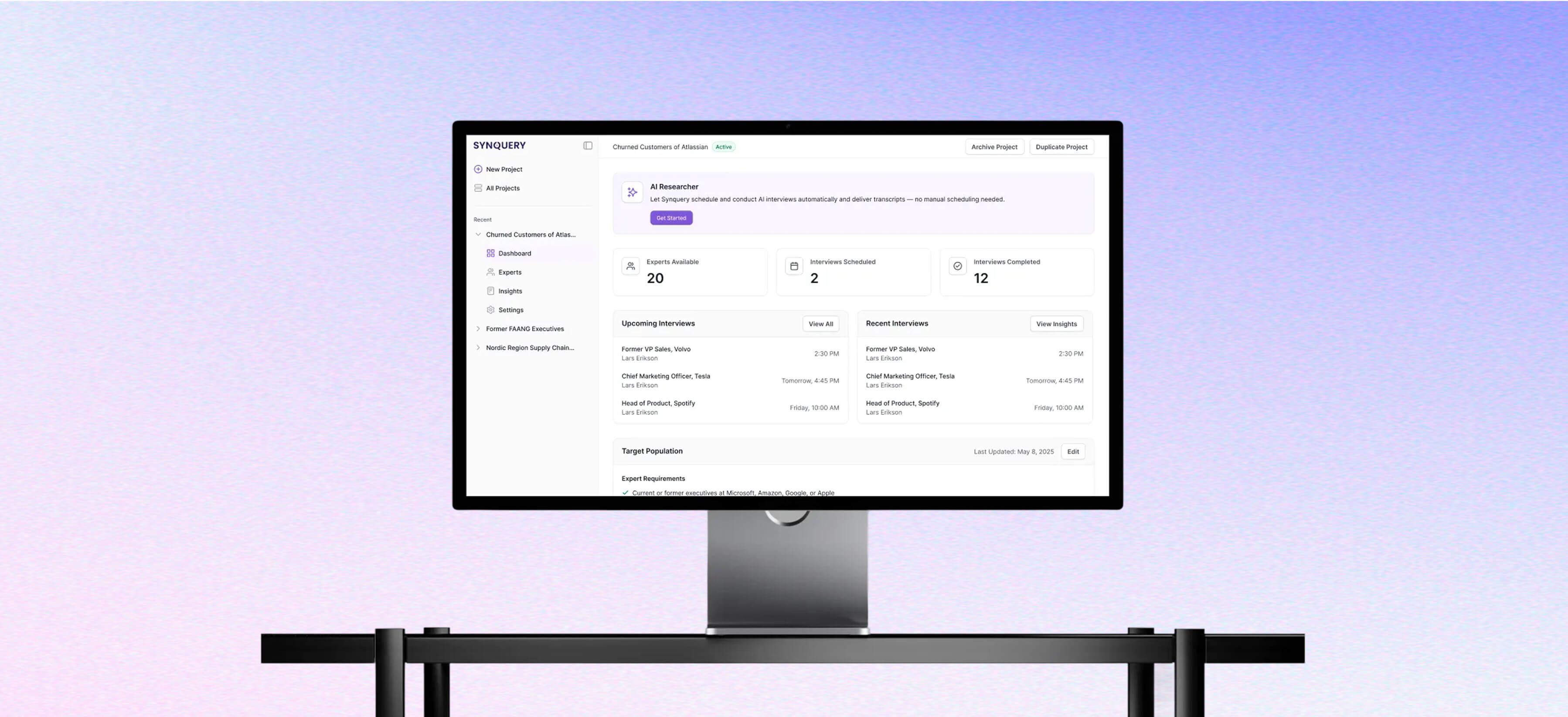
What you built
- Proves the idea and the demand.
- Defines the scope precisely.
- Becomes the specification.
Audit, redesign, architect, and productionize what you built in Lovable, Figma Make, Claude, v0, or Replit, into software you can actually ship, sell, and maintain.
The gap
Modern tools are extraordinarily good at getting an idea to the point where people believe it. They are not designed to get it to the point where a customer depends on it.
The happy path is solid because you built it and you know the route. Everything either side of that route is undefined.
Every screen was invented separately. Nothing composes, and the product gets less coherent with each feature added.
Data model, state, and auth were expedient choices rather than decisions. They hold until they very suddenly don't.
Keyboard navigation, focus management, contrast, and semantics. Increasingly a procurement blocker, not a nice-to-have.
Laid out at one width, on one machine, by one person. Real breakpoints were never a constraint.
Empty, loading, error, permission, offline, and partial-failure states are the bulk of real product surface area.
What you have
This is not a page about prototypes being bad. Getting to a convincing prototype is genuinely valuable, and it de-risks everything that follows.
| Your prototype proved | It hasn't yet established | |
|---|---|---|
| 01 | The idea is worth building | A design system anything can scale on |
| 02 | Roughly what the core flow should be | An architecture that survives the roadmap |
| 03 | That users respond to the concept | Accessibility or responsive behaviour |
| 04 | Enough to raise or to get a design partner | Error, empty, and permission states |
| 05 | A working specification of intent | Security, auth, and data boundaries |
| 06 | Which features nobody actually asked for | Anything a second engineer can work in |
01
02
03
04
05
06
The actual work
We go through the prototype properly: code, data model, dependencies, auth, and which parts are genuinely load-bearing versus scaffolding.
Flows, information architecture, hierarchy, and the jobs the product actually does, separated from the shape the prototype happened to take.
Tokens, components, and states, defined once in Figma and in code, so the tenth screen costs a fraction of the first.
Data model, state management, API boundaries, auth, permissions, and environments, decided deliberately this time.
Rebuild on a stack that can carry the roadmap, reusing whatever from the prototype genuinely deserves to survive.
WCAG 2.2 AA as a build standard: semantics, keyboard paths, focus management, contrast, and screen reader passes.
Real breakpoints against real content, including the dense data views that prototypes quietly avoid.
Empty, loading, error, permission, and failure states designed and built, then tested systematically rather than demoed.
Usually it becomes the specification. It is the clearest possible statement of what you wanted, and it's far more useful than a requirements document.
Occasionally chunks of it survive into production. More often the value was in what it taught you, and rebuilding is cheaper than untangling.
Approach
AI stays in the workflow throughout. It accelerates production and catches the checks humans shouldn't do by hand. The decisions stay with designers and engineers.
Process
Product goals, users, the prototype itself, the roadmap, and what has to be true for this to be a business.
Information architecture, content and data model, design system plan, technical architecture, and a build sequence.
A component-based interface system designed against real data and the states the prototype skipped.
Production build on a modern stack, shipped in slices, with preview environments from the first week.
Accessibility audit, responsive QA, performance, analytics instrumentation, and systematic functional testing.
Deployment, environments, monitoring, analytics verification, then handover documentation and support.
Honest assessment
If you're still testing whether anyone wants this, keep prototyping. This work is for the moment after that question is answered.
React · Next.js · TypeScript · Tailwind · Supabase · Postgres · Stripe · Vercel · Figma · Sentry
Tools: React, Next.js, Vercel, Figma
Starting points
Built it somewhere else? We'll still audit it.
Full-stack prototypes with a real data layer, usually the closest to production and the most tempting to ship too early.
Strong component output that needs a design system, state architecture, and the states it never generated.
Genuinely capable application code that needs architectural decisions made deliberately rather than per-prompt.
Working software in a hosted sandbox that needs environments, auth boundaries, and a deployment story.
A convincing interactive prototype that needs a real data layer and a component system underneath it.
Fast full-stack scaffolding that needs the architecture, accessibility, and edge cases filled in.
Relevant work
FAQs
Sometimes, and we'll tell you honestly which it is after the audit. The prototype's real value is usually as a specification. It removes the ambiguity that makes product work expensive.
Yes. We can own design and hand off, design and build the front end alongside your team, or take the whole thing. Most engagements are the middle one.
A focused product surface is typically ten to sixteen weeks. Broader platforms with permissions, billing, and integrations run longer, and we'd sequence it into shippable slices.
Eventually you should. This work is what makes that hire productive on day one instead of month four: a design system, an architecture, and a codebase someone can join.
Constantly, for production work and for the checks humans shouldn't do manually. The architecture and design decisions stay with senior people, which is the entire point of hiring us.
Then this probably isn't the right time. Keep prototyping until the idea is validated, and come back when customers are about to depend on it.